Carlos and I landed in Morocco after a seven-hour overnight flight. We spent our first two nights in Casablanca, against the advice of nearly everyone on the internet. When we’d search for sightseeing ideas in online forums, at least 30% of respondents urged us to leave Casablanca immediately and travel to a more exciting area like Marrakech or Fes. It’s not an unfriendly city, but it’s certainly not the pride and joy of Morocco. The overall vibe of the region could be characterized by the statement: “Welcome to Casablanca… Are you sure you’re in the right place?”
Despite the warnings of well-meaning strangers, Carlos and I had a fun time in the city. On our first evening in Morocco, we walked to a restaurant called Dar Filali, where we met Mr. Filali himself. He ushered us into the restaurant and introduced us to his son, Muhammad, who seated us at the restaurant’s singular balcony table. Muhammad gave us a tour of the place and explained the historical significance of this building and others in the neighborhood; the edifice across the street was the first building established by the French during their occupation of Morocco in 1921. After our tour, Muhammad asked if there was anything we couldn’t eat. When we said no, he assured us that he would take care of us and introduce us to a variety of Moroccan dishes.
Our servers were two young women who seemed delighted by my interest in the Arabic language. They taught us how to say “good” (mezzien), “delicious” (benin), and “Eat!” (Kuli!). In low voices, they taught me how to talk about “a man who is trouble.” When I said the words to Carlos, they erupted into laughter; I asked if it was a bad thing to say, and they laughed again. “Yes,” they said, “Don’t say it anymore!”
They also directed our attention to Arabic proverbs which decorated the walls of the restaurant. They translated a few for us, explaining that they could be difficult to understand at first, but encouraging us to look for the deeper meaning. One said: “When you are hungry, eat pomegranate. When you are not hungry, eat pomegranate.”
“You see, pomegranate seeds are very small,” our server explained wisely.
Dinner was delicious. We ate several cold salads containing eggplant, potatoes, beets, and tomatoes; I probably would have been content solely with these. Our main course, however, was even better. We each had our own tagine, a traditional Moroccan dish served in a distinctly shaped clay pot surrounded by vegetables, olives, and a flavorful broth. Our servers showed us the correct way to eat the tagine by ripping off a piece of bread and using it to transport the meat from dish to mouth.
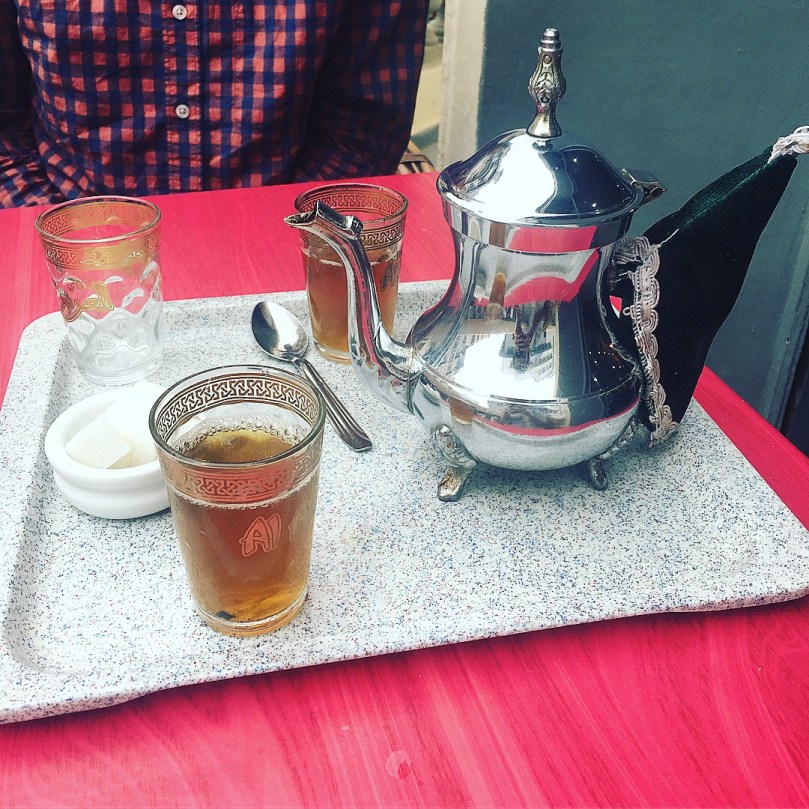
After our meal, we were treated to a pot of Moroccan mint tea and a cold dessert called jawhara; these were on the house as a honeymoon gift to us. Both were sweet and refreshing. We learned that the proper way to pour mint tea is to hold the pot about a foot above the glass and pour; this way, bubbles form on top of the tea.
Upon leaving the restaurant, we saw Mr. Filali once again. He high-fived us and invited us back again anytime. “This is a good man,” he told me, patting Carlos on the shoulders.
 Laura and Carlos: Adventure Tracker